


Reading time: 6 minute
Forex trading is often seen as a fast path to financial freedom, but the reality is very different. The market rewards preparation, discipline, and consistency more than excitement or luck. Many traders enter the market with high expectations but without a structured approach, and this is where most failures begin. A profitable journey in forex is not built on random trades; it is built on a clear, well-tested trading plan that guides every decision you make.
A forex trading plan is not just a document—it is your personal roadmap in the market. It defines when you enter trades, when you exit, how much risk you take, and how you manage your emotions. Without it, trading becomes emotional gambling. With it, trading becomes a structured business.
In this guide, you will learn step by step how to develop a profitable forex trading plan that is practical, realistic, and designed for long-term success.
Understanding What a Forex Trading Plan Really Is OR Profitable forex trading plan
A forex trading plan is a written set of rules that defines how you will trade the market from start to finish. It removes emotional decision-making and replaces it with logic and structure. Think of it as a business plan for trading.
A strong trading plan answers questions like:
- When exactly should I enter a trade?
- When should I exit a losing trade?
- How much money should I risk per trade?
- What market conditions should I avoid?
- What trading strategy do I follow?
- How do I evaluate my performance?
Without clear answers to these questions, traders often act on impulse. One trade is based on fear, another on greed, and another on random advice from social media. This inconsistency is the number one reason traders lose money in forex.
A trading plan does not guarantee profits every time, but it ensures that over time, your decisions become consistent enough to produce long-term profitability.
Why Most Forex Traders Fail Without a Plan
Before learning how to build a trading plan, it is important to understand why so many traders fail without one. The forex market is not the problem—the lack of structure is.
Most traders struggle because they:
- Enter trades without a clear strategy
- Risk too much money on a single trade
- Chase the market after missing moves
- Close winning trades too early out of fear
- Hold losing trades too long hoping for recovery
- Switch strategies constantly without testing
These behaviors are emotional, not logical. The market simply amplifies human psychology. Without rules, emotions take control.
A trading plan acts like a shield. It protects you from emotional decisions and keeps you focused on long-term consistency instead of short-term excitement.
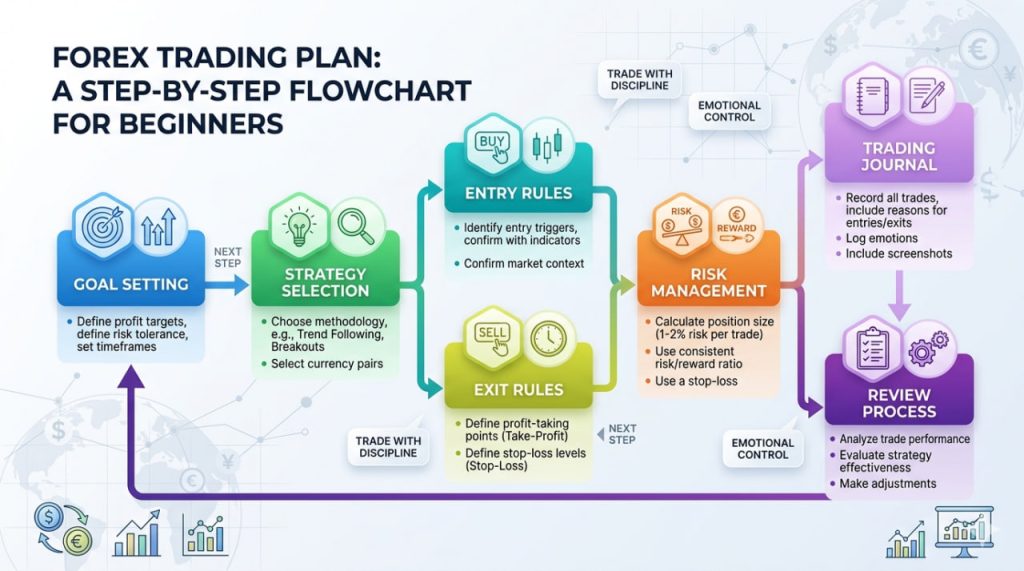
Step 1: Define Your Trading Goals Clearly IN Profitable forex trading plan
Every profitable trading plan starts with clear and realistic goals. Many beginners make the mistake of aiming for unrealistic returns like “doubling the account every week.” This mindset leads to overtrading and account blow-ups.
Instead, your goals should be:
- Specific
- Realistic
- Measurable
- Time-bound
For example, a good trading goal might be:
“To achieve 5%–10% monthly growth with controlled risk and consistent execution.”
This type of goal focuses on sustainability rather than gambling-like returns.
You should also define personal goals such as:
- How many hours per day you will trade
- Whether trading is full-time or part-time
- Your income expectations from trading
- Your acceptable level of risk
When your goals are clear, your trading decisions become more focused and disciplined.
Step 2: Choose a Trading Style That Fits Your Personality
Not all trading styles suit everyone. A profitable trading plan must match your lifestyle, patience level, and emotional control.
There are four main trading styles:
Scalping:
Fast trades lasting seconds to minutes. Requires high focus and quick decision-making.
Day Trading:
Trades are opened and closed within the same day. No overnight positions.
Swing Trading:
Trades last days or weeks. Requires patience and less screen time.
Position Trading:
Long-term trades based on fundamental trends. Can last months.
If you are impatient, scalping may feel stressful. If you cannot monitor charts often, day trading may not suit you. The goal is to choose a style that feels natural, not forced.
Consistency becomes easier when your trading style matches your personality.
Step 3: Build a Clear Trading Strategy
Your trading strategy is the heart of your trading plan. It defines exactly how you identify trading opportunities.
A good strategy includes:
- Entry conditions
- Exit conditions
- Market structure rules
- Indicator usage (if any)
- Timeframes used
For example, a simple strategy might include:
- Only trade in the direction of the trend
- Enter after a pullback to support or resistance
- Use confirmation signals like candlestick patterns
- Avoid trading during high-impact news
The key is simplicity. Complex strategies often fail because they are hard to follow in real-time. A profitable trading plan focuses on clarity, not complexity.
Before going live, your strategy should be tested thoroughly using historical data (backtesting). This helps you understand how it behaves in different market conditions.
Step 4: Master Risk Management (The Most Important Part) In Profitable forex trading plan
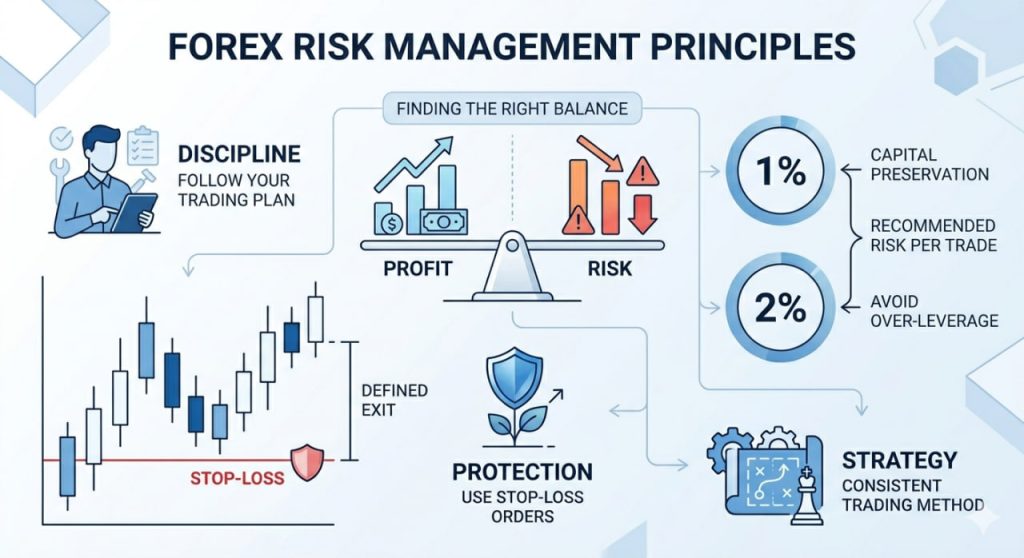
Risk management is what separates profitable traders from losing traders. Even the best strategy in the world will fail without proper risk control.
A strong trading plan includes strict risk rules such as:
- Risk only 1%–2% per trade
- Set stop-loss on every trade
- Never move stop-loss emotionally
- Avoid revenge trading after losses
For example, if you have a $1,000 account and risk 2% per trade, your maximum loss per trade is $20. This ensures that even a losing streak will not destroy your account.
Risk management is not about avoiding losses completely. It is about ensuring that losses are small and controlled while profits are allowed to grow.
Many traders fail not because they lose trades, but because they risk too much when they lose.
Read: Institutional Order Flow Explained (Smart Money Trading Guide 2026)
Step 5: Define Entry and Exit Rules Clearly in Profitable forex trading plan
One of the biggest mistakes traders make is entering trades without clear confirmation and exiting based on emotions.
Your trading plan should clearly define:
- When exactly to enter a trade
- What confirms your entry signal
- Where your stop-loss is placed
- Where your take-profit is set
For example:
- Enter buy trades only when price breaks resistance and retests it
- Stop-loss placed below recent support
- Take-profit at next resistance level
When these rules are written and followed strictly, trading becomes systematic rather than emotional.
Exit strategy is just as important as entry. Many traders know when to enter but do not know when to exit, which leads to lost profits.
Step 6: Include a Trading Journal for Improvement
A trading plan is incomplete without performance tracking. A trading journal helps you analyze your mistakes and improve over time.
In your journal, record:
- Trade entry and exit points
- Reason for entering the trade
- Emotional state during the trade
- Outcome (profit or loss)
- Lessons learned
Over time, patterns will appear. You will see what works and what does not. This is how professional traders improve continuously.
A journal transforms trading from guessing into learning.
Step 7: Backtest Your Strategy Before Going Live
Backtesting means testing your strategy on historical market data. This step is often ignored by beginners, but it is extremely important.
Backtesting helps you:
- Understand strategy performance
- Identify weaknesses
- Build confidence
- Improve entry and exit rules
If a strategy does not work in backtesting, it will not work in live trading. Adjust it before risking real money.
A profitable trading plan is always tested, refined, and proven over time.
Step 8: Develop Trading Discipline and Psychology with Profitable forex trading plan
Even the best plan is useless without discipline. Trading psychology is often the most difficult part of forex trading.
Common psychological challenges include:
- Fear of missing out (FOMO)
- Revenge trading after losses
- Overconfidence after wins
- Emotional decision-making
A strong trading plan protects you from these behaviors by forcing structure.
Discipline means:
- Following your rules even when it feels uncomfortable
- Accepting losses as part of the game
- Not changing strategy emotionally
- Staying patient during slow market conditions
Successful traders are not always the smartest—they are the most disciplined.
Step 9: Adapt Your Plan to Market Conditions
The forex market is constantly changing. A good trading plan is flexible enough to adapt while still maintaining core rules.
Markets can be:
- Trending
- Ranging
- Volatile due to news
Your plan should define what to do in each condition. For example:
- Trade trends during trending markets
- Avoid trading during high-impact news
- Reduce position size during high volatility
Adaptability ensures your plan remains effective in all conditions.
Step 10: Review and Improve Your Trading Plan Regularly
A trading plan is not something you create once and forget. It must evolve.
Set weekly or monthly reviews to:
- Analyze winning and losing trades
- Identify mistakes
- Adjust strategy if needed
- Improve risk management rules
Over time, your trading plan becomes sharper and more efficient.
Consistency in improvement leads to long-term profitability.
Common Mistakes to Avoid When Creating a Trading Plan
Many traders fail because they repeat avoidable mistakes such as:
- Copying other traders blindly
- Ignoring risk management
- Overcomplicating strategies
- Not testing before trading live
- Changing plans too frequently
- Trading without discipline
Avoiding these mistakes alone can significantly improve your results.
Final Thoughts: Building a Profitable Future in Forex
Developing a profitable forex trading plan is not about finding a secret formula. It is about building structure, discipline, and consistency into your trading routine.
A strong plan gives you clarity in uncertain markets. It protects your capital, guides your decisions, and helps you grow step by step instead of chasing unrealistic shortcuts.
Forex trading is a long-term skill. The traders who succeed are those who treat it like a business, not a gamble. When you follow a well-designed trading plan with patience and discipline, profitability becomes a natural result over time.
The real secret is simple: don’t trade randomly—trade with a plan, follow it strictly, and improve it continuously.