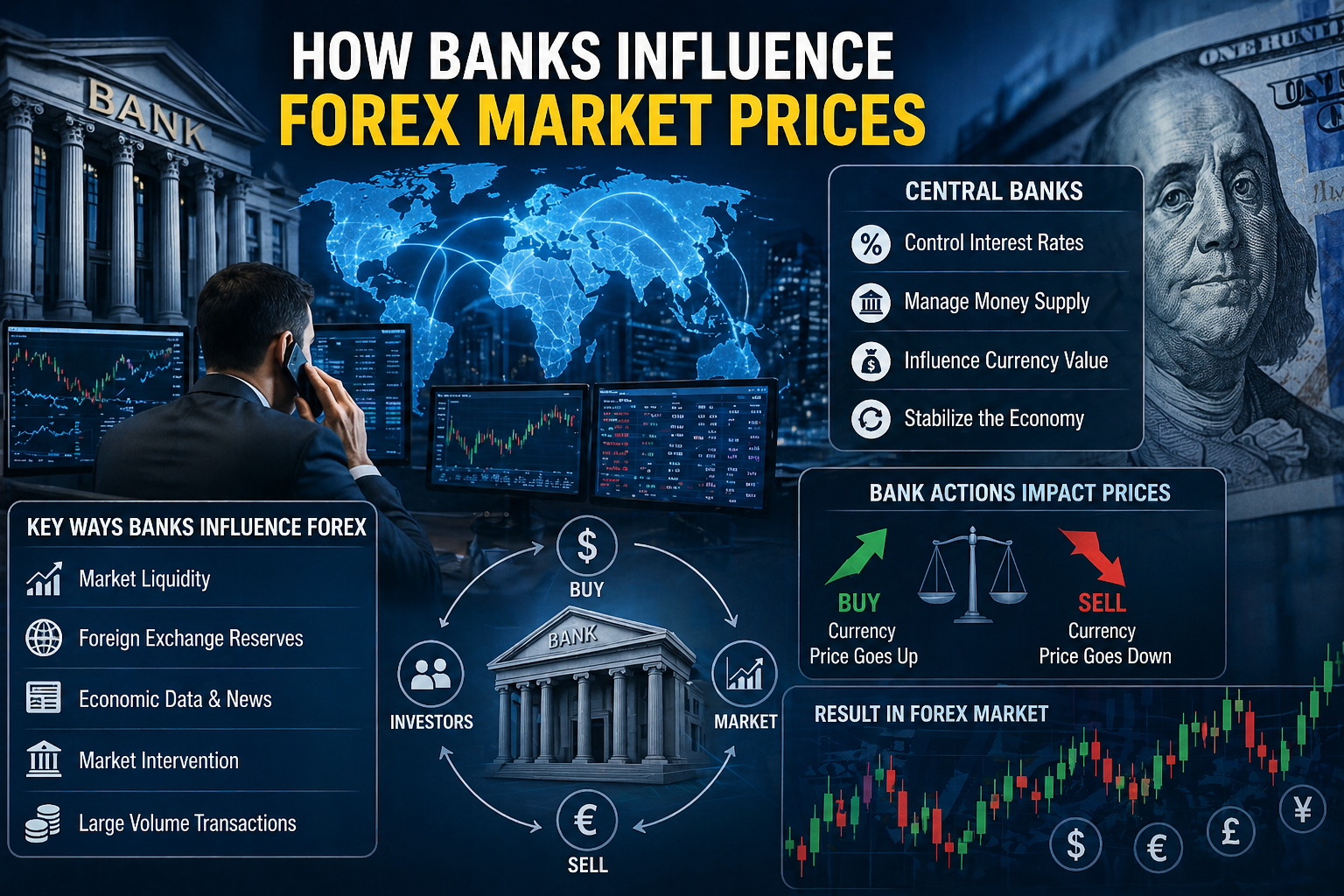

The foreign exchange market, commonly known as Forex, is often described as the largest and most liquid financial market in the world so how banks influence forex market prices. Trillions of dollars move through it every single day, and prices of currencies rise and fall within seconds. While many beginners assume that forex trading is driven mainly by individual traders or simple supply and demand, the reality is very different. The real force behind forex price movements is the banking system OR forex market manipulation by banks.
Banks are not just participants in the forex market—they are the foundation of it. Central banks, commercial banks, and investment banks together control liquidity, influence exchange rates, and shape long-term currency trends. Without them, the forex market would not even exist in its current form.
To understand forex trading properly, you must first understand how banks influence currency prices. This knowledge is what separates beginner traders from advanced market participants.
The Role of Banks in the Forex Market With How Banks Influence Forex Market Prices
Banks are the largest and most powerful participants in the forex market. They trade on behalf of governments, corporations, hedge funds, and even themselves. When you see price movements in EUR/USD, GBP/USD, or USD/JPY, those movements are largely driven by bank activity.
There are three main types of banks that influence forex prices:
First, central banks such as the Federal Reserve in the United States, the European Central Bank, the Bank of England, and others. These institutions control monetary policy and interest rates.
Second, commercial banks such as JPMorgan Chase, HSBC, CitiBank, and Deutsche Bank. These banks handle large-scale currency transactions for businesses and investors.
Third, investment banks and institutional banks that manage hedge funds, asset managers, and global investment flows.
Together, these banks dominate forex trading volume. Retail traders make up only a very small fraction of the market, which means they mostly follow the direction set by banks rather than creating it.
Central Banks and Their Influence on Currency Value Or Forex Market Manipulation By Banks
Central banks are the most powerful institutions in the forex market. Their decisions can move entire currency markets within seconds. One of the strongest tools they use is interest rates.
When a central bank increases interest rates, it becomes more attractive for foreign investors to invest in that country’s currency. This is because higher interest rates offer better returns on savings and investments. As a result, demand for that currency increases, and its value rises in the forex market.
On the other hand, when a central bank lowers interest rates, borrowing becomes cheaper, but savings become less attractive. Investors may move their money to other countries offering higher returns, causing the currency to weaken.
This simple mechanism is one of the most important drivers of forex price movements.
For example, when the US Federal Reserve raises interest rates, the US dollar often strengthens against other currencies. Similarly, when the European Central Bank adopts a loose monetary policy, the euro may weaken.
Money Supply and Inflation Control With How Banks Influence Forex Market Prices
Another major way banks influence forex prices is through control of money supply. Central banks have the ability to print money or reduce liquidity in the economy. This is known as monetary policy.
When a central bank increases money supply, more currency enters circulation. If the supply of money increases too quickly without matching economic growth, inflation rises. Inflation reduces the purchasing power of a currency, which often leads to a decrease in its value in the forex market.
On the other hand, when a central bank reduces money supply or tightens monetary policy, it can strengthen the currency. This is because scarcity increases value, especially when economic conditions remain stable.
This relationship between money supply, inflation, and currency value is one of the key reasons forex markets react strongly to central bank announcements.
Foreign Exchange Reserves and Market Intervention in Forex Market Manipulation By Banks
Central banks also hold large reserves of foreign currencies, gold, and other financial assets. These reserves are used to stabilize the national currency when necessary.
Sometimes, a currency may become too strong or too weak due to market speculation or economic shocks. In such cases, a central bank may intervene directly in the forex market.
For example, if a currency is falling too quickly, the central bank may buy its own currency using foreign reserves. This increases demand and helps stabilize or strengthen the currency. If a currency becomes too strong and hurts exports, the central bank may sell its currency to weaken it.
These interventions can cause sudden and significant price movements in forex markets, often surprising retail traders.
The Interbank Market: Where Real Price Formation Happens
Most people do not realize that the real forex market is not the one they see on trading apps or platforms. The true market exists in what is called the interbank market.
The interbank market is where large banks trade currencies directly with each other. These trades involve extremely large volumes and determine the actual exchange rates of currencies.
Retail brokers simply take prices from this interbank market and display them to traders. This means that retail traders are always reacting to prices created by banks, not influencing them.
Because of this structure, understanding bank behavior is essential for predicting forex price movements accurately.
Liquidity Creation and Market Stability With Forex Market Manipulation By Banks
Banks also play a critical role in providing liquidity to the forex market. Liquidity refers to how easily a currency can be bought or sold without causing major price changes.
When banks provide liquidity, they ensure that there are always buyers and sellers in the market. This allows transactions to happen smoothly even when trade volumes are extremely large.
Without banks, the forex market would be unstable and unpredictable. Prices would jump drastically due to lack of participants. Banks help reduce this volatility by continuously supplying buy and sell orders.
This is one of the reasons forex is the most liquid financial market in the world.
Economic Data and Early Market Positioning in How Banks Influence Forex Market Prices
One of the most powerful advantages banks have over retail traders is access to information and analysis. Banks employ large teams of economists, analysts, and researchers who study economic data in detail.
Before major economic news is released to the public, banks often already have expectations about the outcome. Based on this analysis, they position themselves in the market early.
For example, if banks expect inflation data to be high, they may already start buying or selling currencies before the official announcement.
This is why forex markets often move before major news is released. Retail traders usually react after the move has already started, while banks act earlier based on expectations.

Market Making and Short-Term Price Movements
Large banks also act as market makers in the forex market. This means they provide both buy and sell prices to ensure continuous trading.
In doing so, they sometimes influence short-term price movements. This is not manipulation in a illegal sense, but rather a natural result of liquidity management.
However, these actions can create what traders call “fake breakouts” or “stop hunts,” where price briefly moves in one direction before reversing. These movements often happen when banks are executing large orders and need liquidity.
Understanding this behavior helps traders avoid entering trades at the wrong time.
The Influence of Central Bank Announcements Or Forex Market Manipulation By Banks
Central bank announcements are among the most important events in forex trading. Whenever a central bank announces changes in interest rates, inflation outlook, or monetary policy, the market reacts instantly.
These announcements can cause extreme volatility, with currency prices moving sharply within seconds or minutes.
Read: Top Forex Trading Tools Every Trader Needs (2026 Complete Guide)
For example:
- Interest rate increase usually strengthens a currency
- Interest rate decrease usually weakens a currency
- Economic uncertainty statements often create volatility
Traders around the world closely monitor central bank meetings because they often determine the direction of currency trends for months or even years.
Long-Term Currency Trends and Bank Behavior
Banks do not only influence short-term price movements; they also shape long-term trends. Currency strength or weakness over months or years is often the result of consistent monetary policy and economic performance guided by central banks.
For example, if a country consistently maintains high interest rates and strong economic growth, its currency tends to strengthen over time. If a country struggles with inflation and weak economic growth, its currency tends to weaken.
Institutional investors and banks follow these macroeconomic trends and adjust their portfolios accordingly. This creates long-term forex trends that retail traders often try to follow.
Why Retail Traders Must Understand Banks
Retail traders often focus on technical indicators, chart patterns, and short-term signals. While these tools are useful, they are not enough on their own.
Without understanding how banks operate, traders may misinterpret market movements and enter trades at the wrong time.
Successful traders often follow a simple principle:
Trade in the direction of banks, not against them.
This means understanding interest rates, economic policy, liquidity flow, and institutional behavior.
When traders align their strategies with bank-driven trends, their chances of success increase significantly.
Final Thoughts Of How Banks Influence Forex Market Prices
Banks are the true architects of the forex market. They control liquidity, influence interest rates, manage currency supply, and shape both short-term and long-term price movements.
Central banks set the direction of monetary policy, commercial banks facilitate global transactions, and investment banks drive large-scale market flows. Together, they create the structure within which forex trading exists.
For any trader who wants to succeed in forex, understanding bank behavior is not optional—it is essential. The more you understand how banks think and operate, the better you can interpret market movements and make informed trading decisions.
Forex trading is not just about charts or signals. It is about global economics, financial power, and institutional decision-making. And at the center of it all are banks.
Read: How Interbank Forex Market Works: Behind the Scenes of Currency Pricing