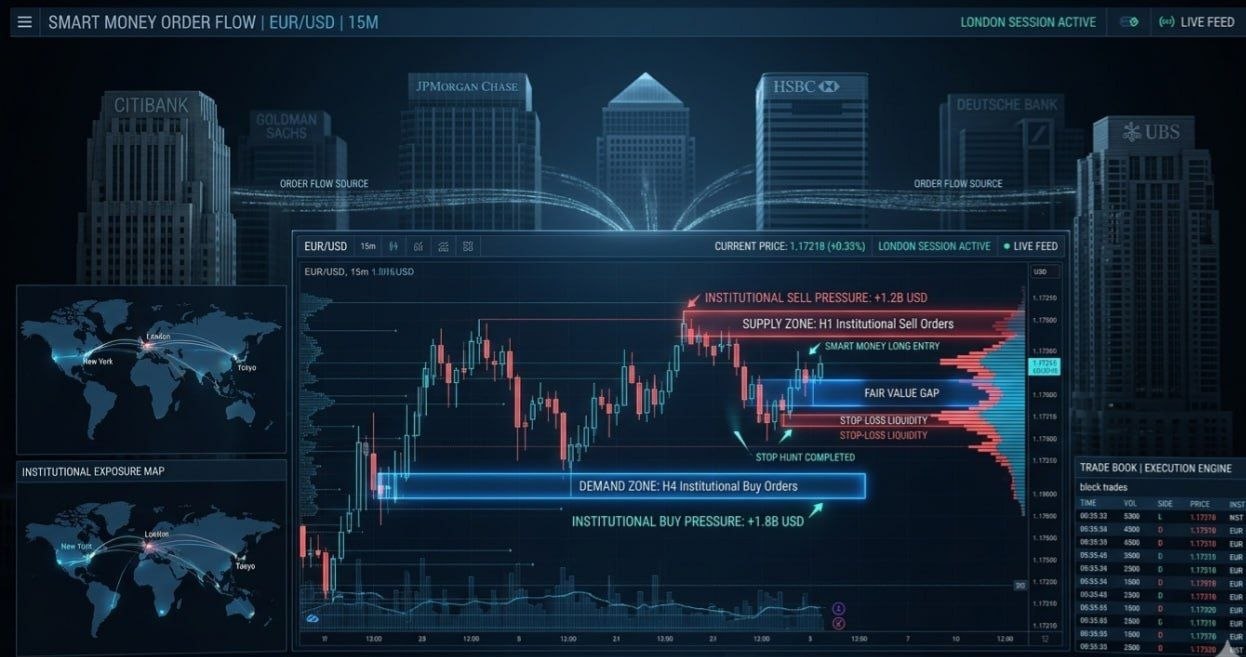

Introduction: The Real Engine Behind Forex Price Movement
When most traders look at forex charts, they focus on indicators, candlestick patterns, and signals. However, professional traders and financial institutions see something completely different in Institutional Order Flow in Forex. They see order flow—the real-time battle between buyers and sellers that actually moves the market.
Institutional Order Flow is one of the most important concepts in Smart Money trading because it reveals how banks, hedge funds, and liquidity providers execute massive trades without disrupting the market too much.
In this SEO-optimized and humanized guide, you will learn what institutional order flow is, how it works, how to read it on charts, and how to use it to trade like professional market participants in 2026.
1. What Is Institutional Order Flow in Forex?
Institutional order flow refers to the actual buying and selling activity of large financial institutions that control the majority of forex market liquidity.
In simple terms:
👉 Order flow = the real-time pressure of buyers vs sellers in the market
Unlike retail traders, institutions do not trade with small positions. They place large orders that require liquidity to be filled efficiently. Because of this, they must carefully manipulate or guide price into areas where enough liquidity exists.
This is why the market often moves in structured, predictable waves rather than random chaos.
2. Why Order Flow Matters in Forex Trading
Understanding order flow gives traders a deeper insight into why price moves instead of just where it moves.
Most retail traders only see:
- Candles going up or down
- Indicators crossing
- Patterns forming
But institutional traders see:
- Where liquidity is sitting
- Where stop losses are clustered
- Where large orders can be filled
This difference is what separates losing traders from consistently profitable ones.
3. How Institutions Control Order Flow
Big players such as banks and hedge funds cannot enter the market freely like retail traders. If they try to buy or sell huge positions instantly, they would cause massive price spikes.
Instead, they control order flow through:
- Liquidity manipulation
- Stop hunts
- Inducement moves
- Fake breakouts
Their goal is simple:
👉 Fill large positions at the best possible price
To achieve this, they need retail traders to provide liquidity.
4. The Relationship Between Order Flow and Liquidity in Institutional Order Flow in Forex
Order flow and liquidity are directly connected.
Liquidity is the fuel. Order flow is the engine consuming that fuel.
Without liquidity, institutional orders cannot be executed.
Liquidity is found in:
- Stop losses above highs
- Stop losses below lows
- Breakout trader entries
- Consolidation zones
Institutions push price toward these areas to activate orders and create liquidity for execution.
5. Types of Institutional Order Flow
5.1 Bullish Order Flow
Occurs when buying pressure dominates the market.
Characteristics:
- Higher highs
- Strong impulsive candles upward
- Breaks of structure in bullish direction
5.2 Bearish Order Flow
Occurs when selling pressure dominates.
Characteristics:
- Lower lows
- Strong bearish momentum
- Breakdown of support levels
5.3 Balanced Order Flow in Institutional Order Flow in Forex
Occurs in consolidation phases where buying and selling are temporarily equal.
This phase is often used for:
- Accumulation
- Distribution
- Preparation for expansion
6. How to Read Order Flow on a Chart
To read order flow effectively, you must focus on price behavior instead of indicators.
Key elements include:
- Candle strength
- Market structure shifts
- Liquidity sweeps
- Momentum changes
A strong bullish order flow usually shows:
- Large bullish candles
- Minimal retracement
- Clean breaks of resistance
A strong bearish order flow shows the opposite.
7. Order Flow vs Market Structure
Market structure shows the direction of the market. Order flow shows the strength behind that direction.
| Concept | Meaning |
|---|---|
| Market Structure | Direction of price movement |
| Order Flow | Strength of buying/selling pressure |
Both must align for high-probability trades.
8. How Order Flow Creates Trends
Trends are not random. They are built through consistent order flow imbalance.
For example:
- Buyers dominate → bullish trend starts
- Liquidity builds above highs
- Institutions push price higher
- Continuation occurs after minor retracements
The same process happens in reverse for downtrends.
9. Institutional Order Flow Cycle with Institutional Order Flow in Forex
The forex market moves in repeating cycles:
1. Accumulation
Institutions quietly build positions.
2. Manipulation
Price moves against retail traders to create liquidity.
3. Expansion in Institutional Order Flow in Forex
Strong directional move occurs.
4. Distribution
Institutions exit positions gradually.
This cycle repeats continuously in all markets.
Read: How Banks Influence Forex Market Prices (Complete 2026 Guide)
10. Order Flow and Smart Money Concept
Institutional order flow is the foundation of Smart Money trading.
It connects directly with:
- Liquidity zones
- Order blocks
- Fair value gaps
- Inducement
Without understanding order flow, Smart Money concepts lose meaning.

11. How Institutions Use Order Flow to Trap Retail Traders
Retail traders often fall into predictable behavior patterns.
Institutions exploit this by:
- Creating fake breakouts
- Inducing early entries
- Triggering stop losses
Once liquidity is collected, the real move begins.
12. Order Blocks and Order Flow Connection
Order blocks are created because of institutional order flow.
A bullish order block forms when:
- Strong buying pressure enters the market
- Price leaves a consolidation zone quickly
A bearish order block forms during strong selling pressure.
13. Order Flow in Trending Markets
In strong trends:
- Order flow is heavily imbalanced
- Retracements are shallow
- Momentum is consistent
Traders should align with dominant order flow direction.
14. Order Flow in Ranging Markets with Institutional Order Flow in Forex
In consolidation:
- Order flow is balanced
- Institutions accumulate positions
- Liquidity builds on both sides
This often leads to explosive breakout moves.
15. Advanced Concept: Hidden Order Flow
Not all order flow is visible.
Institutions often use:
- Iceberg orders
- Algorithmic execution
- Layered liquidity distribution
This creates hidden pressure behind price movement.
16. How to Trade Using Order Flow
A simple Smart Money approach:
Step 1: Identify market structure
Determine trend direction.
Step 2: Mark liquidity zones
Locate highs and lows.
Step 3: Observe order flow strength
Look for momentum and candle behavior.
Step 4: Wait for confirmation
Do not enter prematurely.
Step 5: Enter with institutional direction in Institutional Order Flow in Forex
Align with dominant flow.
17. Timeframe Analysis for Order Flow
Professional traders use multiple timeframes:
- Higher timeframe: overall order flow direction
- Medium timeframe: structure and zones
- Lower timeframe: precise entry timing
18. Common Mistakes in Order Flow Trading
Mistake 1: Trading against dominant flow
Mistake 2: Ignoring liquidity zones
Mistake 3: Entering without structure confirmation
Mistake 4: Overtrading weak setups
19. Psychological Aspect of Order Flow Trading
Order flow trading requires patience and discipline.
Traders often fail because they:
- Chase price
- Ignore structure
- Enter emotionally
Professional traders wait for order flow confirmation before acting.
20. Real Market Example
EUR/USD scenario:
- Market is in uptrend
- Consolidation forms
- Inducement moves retail traders short
- Liquidity is taken
- Strong bullish order flow begins
- Price continues higher
21. Why Order Flow Is Powerful
Order flow reveals:
- Institutional intent
- Market pressure direction
- Real strength behind price movement
It removes guesswork from trading.
22. How to Practice Order Flow Analysis
Step 1: Study historical charts
Step 2: Identify strong vs weak moves
Step 3: Mark liquidity zones
Step 4: Backtest reactions
Step 5: Apply in demo trading
23. Advantages of Order Flow Trading
- Clear market understanding
- Better timing entries
- Higher probability setups
- Aligns with institutional behavior
24. Limitations
- Requires experience
- Hard for beginners
- Needs multi-confluence confirmation
25. Final Thoughts
Institutional order flow is the hidden engine behind every forex movement.
Once you understand how order flow works, you stop seeing charts as random and start seeing them as structured liquidity-driven movements.
The goal of trading is not to predict price—but to follow the flow of institutional money.